the adventures of a girl, her dog, and two cats.
Showing posts with label marine sanitation. Show all posts

Saturday, August 17, 2013

the plan

The plan is actually that there is no plan. Strangely enough, I am very pleased and relieved with this development or realization.

It's ironic that learning to anchor is what sets you free. Wouldn't anchoring imply being tied down? But instead it means you have the freedom to go anywhere you have enough anchor rode to let out. There's mud on my anchor and somehow that means cruising away is that much closer.


I had hoped to head south after boat show this fall. The telecommuting gig I'd been developing not working out seemed to have nixed that plan. But the reality is that, as a practical matter, I simply have to be able to anchor and dock the boat solo, and then I can cast off the lines. As a technical matter, I do have to solve the issue of loading/unloading the dog from a dinghy and get some solar power as well. From a financial perspective, there's no reason I can't hop my way south, gradually reaching Florida and then the islands, and pick up simple unassuming jobs along the way. I have friends here in Annapolis, have put down some shallow roots, but Annapolis will be here whenever I return. The same regulars will be at Davis' Pub, the usual suspects will still be around, and good friends will come visit me as I chart new adventures. So, the plan is very loose and flexible, but that is a good thing. There will come a day when the time is right...would it be nice for it not to be in the middle of winter, sure, but you just never know when the stars are going to align. I didn't move aboard to be stuck in one place...isn't the point to go see the world and have some adventures? We may have to do it on a shoestring, but that usually makes it far more interesting anyway.

Yesterday marathon and ultramarathon training began in earnest with a modest 10.4 mile run. Long runs will quickly build to 20 miles over the next six weeks. I am officially registered for the NCR Marathon in late November and then the Seashore Nature Trail 50K in December.


I have no idea who these folks are who keep this water station stocked, but I think I will have to send them a thank you note. On hot days I wouldn't make it through my run with only what my handheld water bottle carries. These folks have some very good runner karma. I wonder if they realize what a difference they make for strangers running through their neighborhood.

I hailed the pump out boat this afternoon. I still can't get used to them calling me "Captain" on the radio.


It was the same guy who has been to the boat before and as usual he was friendly and helpful and asked how things are going aboard for me and the dog. When it came time to pay for the pump out I handed him $10 for the $5 pump out and explained that previously I hadn't known the etiquette for tipping on pump outs. I told him that feeling that a measly $1 tip last time wasn't right, even if it was 20%, I had asked a friend about what's customary and did some research on the boating forums as well. I told him I wrote a whole blog post about tipping for marine services and that even if most sailboaters are as cheap as they are reputed to be, I did not want to fall into that category when it came to tipping dockhands and such. It sounds as if it certainly is a big portion of their pay and much appreciated, and I'd rather be known to treat them well and get prompt service.

In the next few weeks I'll be getting my Basic Keelboat certification. I'll likely be able to singlehand the boat under power before I can singlehand her under sail, but I'll get there before too long. Still working on lining up someone to go up the mast before I change out my running rigging, but before long we'll be hoisting the sails and heading out. I wonder if I can teach the pup dog to grab a sheet and unfurl the jib?

If the trunk of your car looks like this, you might be a liveaboard.


Thursday, July 11, 2013

to insure prompt service

A couple of days ago I had the Harbormaster's mobile pump out boat come by. I had only used the pump out boat once before and at that time two other boats in my small marina also wanted pump outs. I just paid my $5 for the pump out, but it sounded like the other boats tipped the guy. I didn't know what is expected or appropriate, so when I got pumped out the other day I tipped the guy a buck. That's 20% of the $5, but I felt it might have been chintzy and wanted to know the etiquette for tipping in that situation. Oh, did I forget to mention the guy is cute and chatted me up a bit? Regardless, I know well what it's like to depend on tips, so I wanted to make sure I was doing the right thing.

I dropped an email to a friend whose judgment I trust so I could get his advice and view on tipping for pump outs. He definitely tips and tips well; generally $5 on a pump out. He has sailed, but is primarily a power boater. Feeling comfortable now that tipping is called for, and that a $3 to $5 tip for pump out, depending on the service, is a reasonable range, I could have (should have) just moved on. But being curious by nature, I decided to see what the forums had to say about it. And true to form, the forums pretty much make my blood boil.

The reputation that power boaters tip much, much better than sail boaters appears to be very well grounded in reality. When searching on Sailnet for "tipping pump out" and "tipping marinas" not one relevant search result even appeared. Cruisers Forum had a variety of threads on tipping launch drivers and marina staff or dock hands, and on tipping in US marinas.

Apparently tipping is customary, appropriate, and expected along the US east coast. (I seem to remember my ex tipping dock hands twenties when we were running his brother's 54-foot yacht in Miami and the Keys.) It sounded as though tipping is less common on the west coast, but that dock hands being around to help is also infrequent. The Canadians, Brits, Kiwis, and Aussies mostly showed themselves to be not only cheap, but incredibly resentful of tipping just about anyone, ever. Even when they know very well that it is expected in the US. Not tipping or tipping very little may be the custom in their countries, but it is very bad karma to bring that attitude to the US. I read ridiculous posts along the lines of "employers should simply pay a good wage" and "I don't tip because I only frequent businesses who pay their employees well." Yeah, right. I seriously doubt anyone is out there asking just how much the dock hands are paid before they book a slip at a marina. And who exactly gets to be the arbiter of whether someone's wage is good, livable, or fair?

Make no mistake, in jobs where tipping is traditional--restaurant staff, hairdressers, taxi drivers--tipping isn't "optional." It is part of the price you are expected to pay for the service. If you can't afford to tip 20% then don't eat or drink out.

Many people don't seem to realize that most waiters in the US make effectively nothing. In the Annapolis area servers and bartenders make $3.63 an hour. (Apparently federal law allows it to be as low as $2.13 in some places.) One's "paycheck" is zero because that whopping $3.63 an hour is all withheld for taxes. Whether you tip or not the server has to pay taxes as if you did because the restaurant declares tips for the staff based on the server's sales. The server may also pay 2.5% in credit card processing fees, and usually tips out 10% to the bar and another 15% to the busser.

I saw one post saying it's not fair to have to tip a server since all they do is carry some food, that someone else cooked, to your table. Wow. There's a lot more to it than the time a server spends with you at your table. They arrive hours before the restaurant opens to clean, prepare the dining room and service areas, cut fruit, cut bread, educate themselves on that night's soup and specials, et cetera. Most servers really are there to provide you a high-quality professional service that not just anyone can provide. They almost certainly know and care more about cuisine and wine than 99% of their customers. The ability to stay organized under pressure, timing meals, dealing with rude, difficult, or mean customers, knowing about the food preparation or being willing to check with the chef to accommodate customers' peculiar allergies, diets, or preferences, those are not skills that everyone has and they are not easy to teach. It can be back-breaking work carrying large trays of food and kegs of beer. And it can be soul-sucking work when after recommending the perfect wines and catering to the table's every whim, you find a measly 15% tip.

Tipping actually makes a lot of sense for paying servers and bartenders because the server at a breakfast diner and the server at a fine dining restaurant probably shouldn't be making the same wage. Having it keyed to the cost of the meal often reflects the difference in skills and education needed for the role. In fine dining customers expect the server to know wines that may cost as much as the server will make that night. You would probably be shocked by how many customers I've had who didn't know French or haute cuisine terminology for food and needed me to explain it. Even more frequent were customers who use the wrong bread plate or don't know how to place their silverware to indicate they are ready for the next course. Fine dining is a dance that requires both the server and the customer to know the steps to be truly successful.

But enough ranting about tipping. The bottom line is one should tip, and tip well. It makes a difference. It will insure you prompt service the next time around. It's good for your karma. If you're a sail boater and usually thrifty, be the one to stand out and tip well.

Sail boaters have a well-earned reputation for cheapness and they should not be proud of it. That is not to say it isn't admirable to get by on a tight or small budget, to make the most of everything one has, or to fight for a good deal. Frugality can be admirable; frugality is about not being wasteful of anyone's resources. It benefits both the individual and the commons. Cheapness, on the other hand, is a character flaw. Period. And if a potential romantic interest is cheap, run don't walk. Cheap people are often not just tight-fisted with their money, but also with their time, energy, and physical affection. The last thing anyone wants is to go on a date or hang with a friend who invariably complains about the cost of things or has to find the cheapest deal available. Somehow, money and prices always come up. Quite the opposite, I had a friend who would arrange at the outset for the bill to be taken care of. The last thing he wanted at the end of a wonderful meal was to ruin it with discussion of money.

Tuesday, May 28, 2013

lazing around

The past few days have been cool enough that air conditioning was not a concern and I have been enjoying sleeping with the forward hatch open. I awoke at six this morning with little raindrops coming through the hatch and hitting my face. I hopped up and scrambled around the boat in the twilight to close up open port lights to keep the rain off of books and other stuff and then dropped the forward hatch. The morning has been a rotation of very gentle sprinkles, steady light rain, brief downpours, and dry spells. A friend may have found a used A/C unit to replace my current one, but a rainy day may not be the right time to play around with the largest electrical system on the boat.

I had high hopes for the holiday weekend. I planned to really get the boat cleaned up and company presentable, get the cockpit back to the relaxing environment it was when I first moved aboard. I got off to a good start on Saturday, starting to work my way through the boat with my new mold treatment: a solution of tee tree oil and water. Saturday afternoon I also fiddled around with the VHF radios, (though I never managed to get an automated radio check to work on the inside radio), and hailed the harbormaster's pump out boat. It was my first time using the pump out boat, and I'll enjoy the convenience of that service until it shuts down after boat show. The tank was not yet full after seven weeks.

I was off to a good start, but my Saturday night became more of a party than I had initially planned, and Sunday was spent trying to keep down ginger ale and Gatorade and nibbling Saltines. When I went topsides on Sunday there was wine spilled all over the deck and cockpit. I even found spots of red wine spilled on the dog--what a bad mother I am! (I wasn't actually the one spilling wine everywhere, at least). The kitchen counter was piled with shot glasses. I think a good time was had by all. Well, except my poor tummy, which can no longer handle red wine without a full meal and in small quantities.

Monday I ran out for a meeting midday and then rather than dive into all my projects I lounged on the boat napping and watching almost all of season two of Game of Thrones. Sometimes we all need to just rest and vegetate a bit, I guess this weekend was my turn to laze around.

The big event this weekend at my little marina was the departure of one of my dockmates, the Eleanor Q. Frank and Mary Marie have been preparing their beautiful Gozzard for cruising and have been living aboard her the past few weeks. Memorial Day was the day they finally shoved off and took the dock lines with them. Buttercup will miss Frank throwing a ball for her and following them both around trying to "help" with whatever project they may be working on. They are headed north first and then down to the islands. Check out their blog Voyages of the Eleanor Q. They were great neighbors and will be missed, but hopefully we'll shove off ourselves and run into them in the islands down the line.

I'm frustrated that the remote project I'd been working on since September did not work out. I had been hoping that it would be profitable enough to cover core expenses and allow us to take off and cruise. Unfortunately, it did not turn out to be as profitable as hoped, was plagued with delays and difficulties, and I felt I had to cut my losses rather than continue to bleed time into it. Right now I am not here because I want to be, but because I lack the resources to go. It's not that I dislike it here, but I want my freedom so badly, want to be able to cast off the lines and go wherever, whenever I please. I know, we all want freedom and almost all of us simply have to endure a life without it. But I do not want to surrender so easily, do not want to live each day just to get by.

Another liveaboard friend has started a blog, but not about living aboard. She is undertaking a project in which various of her friends get to write one-month chapters of her life--giving her challenges to test herself, delve into her weaknesses, and embrace personal growth in a very out-of-the-ordinary way. Take a stroll over to living chapters and check it out.

Saturday, April 13, 2013

sweet victory (a/k/a project: vent hose replacement)

It has been longer than usual between posts for me, but owing only to how busy I've been now that the warm weather has arrived and the endless list of boat projects has emerged from winter hibernation.

Before I get into the saga of replacing the vent hoses on the holding tank, I have to share a couple of snaps of this groovy grocery bag I picked up for 99 cents at Trader Joe's. It has liveaboard written all over it...


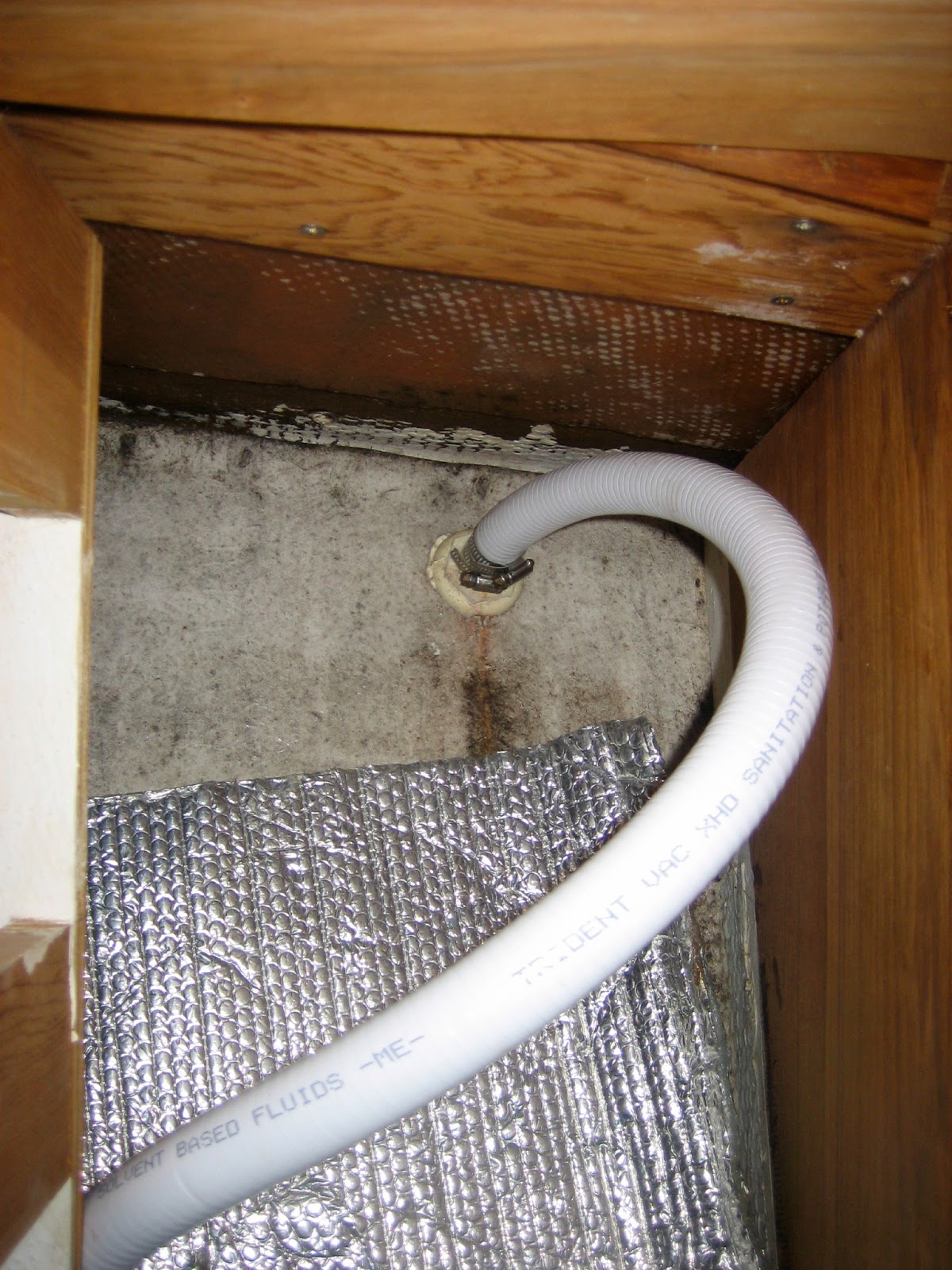
So, we left off at my six-month-aboard anniversary and the old vent hose on the holding tank had thumbed its nose at my attempts to remove it. A good friend volunteered to help me with the project this past Sunday despite my admonishments that it was a tough, smelly task. When we had beaten the job into submission, he wouldn't even let me pick up the tab at Davis'. I'm sure blessed with some great friends!

One of the initial challenges was that I needed better access to the tank fittings, as I had been working only through a small access port. To gain access above the tank we needed to remove the v-berth mattress, which in my boat is one enormous foam mattress (in some boats, the v-berth takes two or three cushions assembled together). The mattress was also it's own "project" that day. Months ago the cats had peed on the mattress before I had managed to cut a protector to fit it, and my treatments with Nature's Miracle had not been thorough enough, so there was occasionally a residual cat pee odor--not pleasant. The winter condensation also meant that mold had returned in the forepeak. Thus, the mattress was it's own icky, smelly project. I would love to get a new mattress, especially as this one is not friendly on my back, but at $2500 and up... the boat repair and outfitting fund can't swing that yet.

The mattress is heavy and unwieldy. Removing it was not an easy job even for the two of us. But we pulled it out, carried it up the side deck, and laid it out on the foredeck in a way that maximized air circulation around it. The sheets had gotten wet and moldy along one side, but the mattress itself did not have any mold. I poured a very hefty dose of Nature's Miracle all over the mattress and let it air out in the sun all afternoon. When the day came to a close and we put the mattress back in I felt there was still some residual smell, so I sprayed the surface again with Nature's Miracle, left the port lights open in the stateroom, and aimed a fan at the mattress. We all spent the night on the settee in the main cabin, with barely any room for me beneath the menagerie of pets.


After another day letting the mattress air out and dry, the offending smells were gone. Virtually any cleaning job can be mastered, but some of them simply require the right product and enough time.

With the mattress out of the stateroom, we could now unscrew the piece of shelving atop the holding tank for open access to the tank fittings. Forward of the holding tank were two storage areas, so I said a little prayer for there to be lots of fancy boat equipment hidden away and forgotten by the prior owners. Alas, the lockers were filled with fiberglass housing insulation, some of which had gotten wet and moldy from condensation and some mystery water that kept seeping into the bottom of one locker (bilge water, presumably). There was also more Reflectix insulation in the lockers as well, which is the boat-appropriate insulation to use. Here are some photos of the lockers. I expect I will put a lot of winter clothes and such in space bags and store them there; the lockers are huge. I could just barely reach the bottom.


Now we were ready to tackle the main project. As one friend/reader had noted, sometimes you have to spend hours prepping to have good access for a job, but then the job will take fifteen minutes instead of five hours. I wish this had been a fifteen minute job, but it surely would have been even tougher had we not removed the mattress first to gain better access. Here's the view of the top of the holding tank.


I left off with a small piece of hose stuck on the port vent fitting. I had tried previously to get a knife under the hose to break the seal that had formed over the years, but even the thinnest knife did not want to shimmy in there. 007 from S/V Octopussy had explained that the fitting is not smooth, but rather has a series of grooves. Once I could actually see that on the fitting I understood why it was so hard to try to pull the hose off--over the years the hose depresses into those grooves, as shallow as they are, and locks itself in. We followed a tip from 007 and repeatedly carefully cut at the hose lengthwise while pulling the hose away with a pair of needlenose pliers to help it split. It was a painstaking process both due to the stiffness of the hose and the fear of damaging the fitting, but it worked well. Although I had tried cutting the hose with this utility knife during my first stab at the project, between being a girl and having a nagging rotator cuff tear, this part of the job really benefited from the brute force a guy could contribute.


We high-fived and congratulated ourselves when we got that hose off. We figured putting the new hose on would be a snap. I had done plenty of studying up from Nigel Calder and Peg Hall (a/k/a The Headmistress) on how to install the hoses. First we pulled the new hose through to gauge that the length was correct. I had erred generously, and we used the hack saw to take off about 18 inches of extra hose. I climbed in the port hanging locker and the hose went on the thru-hull fitting with relative ease. I tightened down the hose clamps with a screwdriver. Yep, we were cruising along now.


Yeah, not exactly. We lubed up the hose and tank fitting with Teflon grease but the hose would not come close to going on that fitting. I boiled some water on the stove, we soaked the end of the hose in it for a minute or so, and it slipped right on. Nigel Calder's not-inexpensive textbook on boat mechanical and electrical systems was well worth the price just for that one tip! (He strongly recommends this approach over use of a heat gun, which has a greater likelihood of damaging the hose). We tightened down the hose clamps and patted ourselves on the back.


Now on to the starboard hose. We sawed off the hose a bit aft of the fitting and followed the same utility knife and needlenose pliers procedure to remove the remaining length of hose. Then came the thru-hull end. Rather than a hanging locker, this thru-hull is tucked behind a set of drawers. We pulled the drawers out and then realized that the drawer frame posed a significant obstacle to accessing the thru-hull. It was a major contortionist exercise to reach the hose clamps with a screwdriver and loosen them enough to be able to free the hose. I tried sliding my head and shoulders sideways through one drawer space but could not quite reach. I then perched beside the drawer frame and reached my arm through as far as possible while my friend shined a flashlight at the hose clamps. Every quarter-turn of the screw was a major accomplishment. We took turns trying to get at the hose clamps and just needing a break from the heat and the residual "eau de holding tank." We sawed off the hose at that end as well, leaving about a foot of hose to grab onto and yank it off the thru-hull. I'm not sure these photos really demonstrate how difficult it was to reach that thru-hull.


When we had removed the old hose we easily followed the same routine of Teflon grease and soaking the new hose quickly in boiling water to attach it to the tank fitting. Then came attaching the new hose to the thru-hull. Reaching in to tighten the hose clamps was the toughest part of the entire project. At least when trying to loosen the old ones we could get torque on the screwdriver because the clamps were tight. But trying to tighten clamps that just want to spin about...impossible. We tightened them down as much as possible before sliding them into place by pushing them with pliers and the screwdriver. But we simply could not reach the screws and get any purchase to tighten them down. We pulled out a borrowed socket set and found a socket that would work. Our momentary joy was quickly squelched when we realized that socket needed a smaller ratchet than we had. I popped out and asked the guy a couple slips down if he had the ratchet we needed. He did. Unfortunately, the handle was too short for us to reach the hose clamp. My friend quickly devised a solution.


So with our taped-together ratchet-screwdriver tool my friend managed to reach in and tighten down the hose clamps. It was still no easy task because the space to maneuver the tool was tight, but it worked. And with luck, that particular job won't need repeating for another ten years.


And so, sweet victory. My friend and I each learned some things from the other during the project and it's always good to have a friend who can McGyver stuff to find a work-around. I have had the luxury of using the head aboard for almost a week now, and offending cat pee and holding tank aromas are a thing of the past. Yep, I'm living the dream.

Tuesday, April 2, 2013

six months aboard

Half a year aboard. I guess that's something of a mini-milestone and the next temporal one will be a year. Yesterday I started early with projects, feeling some momentum to make headway. At least I managed to bail out the dink.

Looking around inside the boat, it appears I've made little to no progress in the past six months. Clothes are in bags and piles. Random clutter inhabits every surface. It seems as if no amount of vacuuming can keep pace with the dog's shedding.

The weather yesterday was beautiful. Finally warm enough to open all the port lights, let in some sun and fresh air. The two projects I really wanted to get to were replacing the holding tank vent hoses and drilling out the hinge screw holes on my companionway door, then filling the holes with epoxy and wood plugs. A warm, dry day is best for epoxy work so that it will cure well. I should have started with the latter project so that perhaps next weekend I could re-sink the hinges and have a functioning door. Instead, I decided to tackle the vent hoses first. Getting rid of the stinky permeated hose would let me put away clothes in the hanging locker and free up space in the cabin, making it easier to clean and organize.

In theory, vent hose replacement is simple. The only tool required is a screwdriver for loosening and tightening the hose clamps. In practice, the job was not so simple. I went to work on the thru-hull connection first. I contorted myself to reach the hose clamps and quickly got them loose. I twisted, tugged, and pulled the hose, but it would not come free from the thru-hull. I worried that the fitting would fall out into the water and considered duct-taping it down outside. Donning my goofy headlamp, a mask for mold and smells, and rubber gloves, I begrudgingly went a couple slips down and asked for help. To be clear, I was only asking for their advice on how to remove the hose. I just don't think you can ask for volunteers with head-related projects; those projects are icky and smelly enough that I think you have to pay real cash money to someone to help. But one guy offered to hold down the thru-hull from the outside while I tried to break the hose free. He seemed to think the thru-hull was not going anywhere and was nice enough to come inside and after some twisting and pulling get the hose free of the fitting.

On to the unpleasant end of the project: disconnecting the hose at the holding tank fitting. The working space there is much smaller unless I disassemble part of the berth, which is likely what I will end up having to do because the starboard vent connection is even harder to reach than the port one I was working on yesterday. I loosened the hose clamps, one of which promptly broke anyway. I was able to twist the hose back and forth on the fitting, but like the other end, it would not come free of the fitting. I figured it may be easier to work with a smaller section of hose, so I used a hack saw to cut the hose away about an inch past the fitting. I stuffed a paper towel in the end of the hose to cut down on the smell and took a study break.


I looked online and found no useful information or handy YouTube videos (apparently no one on Sailnet or Cruisers' Forum has had this problem...not likely, but I can believe they wouldn't admit to it.) I referred to Nigel Calder's Boatowner's Mechanical and Electrical Manual and Peg Hall's Get Rid of Boat Odors. They both have useful information for installing the new hoses, e.g., Nigel Calder suggests dipping the end of the hose in boiling water to soften it to slip over the fitting more easily (rather than using a heat gun), and Peg Hall suggests lubing the fitting up with some K-Y. I will likely use both suggestions. But to remove the old hose that is stuck on the fitting the only advice I've found is to soften it with a hairdryer. I was hoping to avoid that because I will have to link a couple of extension cords together to reach all the way inside the boat since plugging a hairdryer into the boat's electrical system would almost certainly trip the breakers.

Hunter studying up on Nigel Calder's plumbing guidance.
I went back to the project a couple of times, trying to pry the hose off the fitting with a screwdriver, (which risks damaging the fitting), and trying to cut the hose section with a utility knife, which could also have damaged the fitting if the knife hadn't been utterly useless against the hose. I really wanted to finish that project, or at least one of the hoses.

Six months in and I can't even finish this simple project that requires no power tools. I know exactly how to do the job, but I'm not strong enough to pull the stupid hose off the fitting. I hate that feeling of defeat, weakness. I will probably have to hire someone to help me with this simple project, but don't even have the money to hire anyone right now. At least the port hose is removed and I can plug the fitting for now. The tank is still vented to starboard. I can clean the hanging locker again--the moisture and mold keep coming back from the cold weather--line the locker with some insulation, and actually hang some clothes there. I guess I have to find the little success even if I lost the battle against the vent hose for now.

As if my plate wasn't full--though admittedly, no matter how much progress one makes the boat project list never shrinks--I also need to follow up on the water pump. The new pump occasionally cycles on when no faucet is open. That is a sign of a leak. I get weak pressure at the galley sink, but very forceful pressure in the head sink, which is twice the distance from the pump. Investigation has revealed that the separate spray nozzle at the galley sink drips quite a bit when the faucet is on--but does not do so when the faucet is off. It's a leak that needs to be dealt with, and may account for the lag in pressure there, but I don't think it's the cause of the water pump cycling on when it shouldn't. It seems that the cycling on problem occurs when the water heater is on, which I only use for hot water for dishes as it draws a lot of electricity. My working hypothesis right now is that there is a leak somewhere between the water heater and the pump. It's a project I will bring in help for so that I can learn how to find and fix it without further mucking anything up. I also want to know whether I have a heat exchanger on my water heater; if so, I can heat water from the engine's heat when motoring, which would be quite useful when cruising.

Although I am frustrated that I have not made more progress in these six months, that I have not renamed the boat or held boatwarming festivities, I am trying to cut myself some slack and give myself credit for learning how to survive winter aboard a boat, learning how to manage three pets aboard, for embracing a lifestyle I was meant for but that certainly presents its quirks and challenges. I am grateful I have many local friends I can turn to if I want advice, since oftentimes the folks most insistent on offering up their advice aren't the ones whose advice you actually want.

I couldn't pass up these adorable Easter lambs on sale today:


I had a great Easter brunch with good friends. But I do miss Easter baskets. I prefer to give gifts than to receive them; I love to pick something special for someone and see them enjoy opening a gift. And although I am not religious, I am very spiritual and embrace the renewal, fertility, and rebirth that bunnies and eggs represent. Now that spring is blossoming I must focus on renewing myself through running, a rebirth (i.e., renaming) of the boat, and getting the boat in shape for a boatwarming and general entertaining. Progress will come. It has to be our turn for some fair winds.

Wednesday, March 6, 2013

five months and counting

This past Saturday marked five months living aboard. I must not have been focused on that mini-milestone since it didn't occur to me until having dinner with friends who are soon-to-be-liveaboards and I asked "Is today the 2nd?" Indeed, it was, they confirmed.

That is one of the challenges I face living aboard and not having a traditional Monday-through-Friday office job: the days rather blend together. Instead of Mondays and Tuesdays I think in terms of "the day the tide was really low," "the day it never stopped raining," or "the day I filled the water tank." I guess that's not entirely fair, since I do remember certain days of the week have a great food or drink special at this or that local pub or eatery. I couldn't care less about the Wednesday night sailboat races, but I sure do love the "Wednesday night race tacos" at The Boatyard during the season. And just as the days seem to blend together, the day often passes by as I clickity-clack on my laptop unaware of the day slipping into night because my port lights are all covered with insulation. Thus, I tend to have a day or two a week where I don't head ashore to shower until five or six in the evening, and sometimes, like today, simply shower and get right back in my jammies. Like boaters who don't admit running aground, liveaboards who deny they have days like this are simply lying.

But Sunday was quite the event going for a mini-cruise across the creek. I had spoken with someone at a local marina and he agreed to let me bring my boat over to get pumped out as they made the rounds to their liveaboards. The City of Annapolis treats its liveaboard community like dirt so the city's pumpout boat "breaks" early and often. Even if it wasn't "broken" I trust the city would winterize it as long as possible rather than at least breaking winterization once a week to service the many, many liveaboards who stay through the winter here. Many of those liveaboards shrinkwrap their boats to keep snow off the decks and aid in insulation, so even if a dockside pump-out station was open those boats could not get to it. Why does it matter? Well it's all kinds of illegal to just pump overboard. I've heard the fine is $5,000. And, you know, it's kind of wrong and all. But have no illusion, the minor amount of waste boaters might dump into the Bay is pretty much de minimus. The runoff from chicken farms on the Eastern Shore is the culprit for the Bay's pollution. And when storm water causes the waste treatment plants to overflow into the Bay... sigh.  But despite science and reality the liveaboards are scapegoated and get constant wagging fingers about how important it is not to pump overboard. Too bad local, state, and federal government show virtually no interest in making year-round, publicly accessible pump out facilities available (whether dockside stations, pump-out boats, or pump-out trucks) so that complying with the law was not an amazing pain-in-the-ass. So, I was jumping up and down ecstatic at the prospect of cruising over to a marina that has a golf cart with a giant shit-sucking vacuum on it to pump out the boat.

A friend brought his daughter along for the "cruise" and we worked on departure preparations, including disconnecting the shore power and cable and removing the dog ramp, and even tried to start the engine. I wanted to be as prepared as possible before my friend who helps me captain the boat arrived; I am always on "Miami time," i.e., 15 minutes late, so I wanted to have things ready to go for once. But the engine wasn't starting right up and I wasn't sure how much throttle to give it to get it to turn over. For an hour he didn't have much luck either. I had been a bad, bad diesel owner and hadn't started it up in two and half months. Diesels hate the cold and hate to sit. I should be starting the engine and letting it run a little weekly. The four of us crossed our fingers, said little prayers, begged and pleaded, but the engine smoked and sputtered. I was close to giving up but headed below to make coffee for the older folks and cocoa for my friend's daughter. At last the engine turned over and we all jumped and clapped, and I gave a huge sigh of relief. Here we were on a blustery Sunday morning, winds blowing 15 to 20 knots, occasional snowflakes falling, but warming our hands with mugs of coffee or cocoa and off for a pump-out cruise across Back Creek!

It was great to have all of us aboard. My friend's daughter is great with the pup dog, so she was in charge of getting pup to the bow or back to the cockpit and keeping an eye on her. One friend at the helm while two of us handled lines was handy on arrival and essential when we managed to turn around in the fairway so that we could leave the dock moving forward. Reverse has much less maneuverability and we needed as much control as possible with the winds blowing us toward other boats.


I only took the helm for a short jaunt on the return. The winds were something to contend with and I still get nervous when I get particularly close to boats that look like they exceed my insurance policy limits. Over on Spa Creek I expect there were many boats out for the frostbite races, but I only spotted one other boat (also a sailboat under power) transiting Back Creek.

When we returned the tide had fallen enough that we couldn't get the boat far back enough in the slip to re-attach the dog ramp. For a couple of days the pup had to be lifted on and off, a precarious undertaking. She knows I'm not really strong enough to lift her securely and balks. At one point I had to sit, pull her onto my lap, and then lower her down to the boat. Even now that I have the boat closer the ramp keeps falling off as the boat shifts in the wind and tides. I am going to need to relocate the ramp and modify the solution so that it remains more stable.

After lunch we took a look at the shroud where I suspected a bad leak. When we pulled up the cover to see the chainplate connection through the toe rail, we discovered what looks to be plenty of dry rot. This cold and damp time of year is not ideal for addressing these problems, but at least some stop gap measures would be better than nothing. To use Git-Rot one really should dig out all the rot and get the area dry. That simply isn't possible right now. We went ahead and mixed the Git-Rot and started pouring it down beside the chainplate.


The void would seem to fill, then drain, fill, then drain. It drank up the entire batch. We topped off the remaining gaps with 3M 4200 sealant/adhesive and then coated the cover as well. We weren't really sure if that was the source of the leak, but it certainly needed attention and will get more thorough remediation in the Spring. A half hour later I looked over at the area on the cabin sole where the leak would manifest and lo and behold, the Git-Rot was coming out. I may not know the path that leak is taking behind the scenes, but at least now I know the beginning and end points. It's ironic how love of the water brings us to our boats, but the water quickly becomes the enemy we constantly battle to keep outside!

What's the moral of the story in this post? I guess that even when the weather is cold, windy, and gray, even when engines sputter and leaks abound, any time you can cast off the lines with good company is a good day. Living aboard is a challenge, nothing is easy, but I wouldn't trade it for anything.